
EUROPE PARTS · WATER RECYCLING SYSTEMS
WRS 150
Water recycling system
Water recovery for a 150 m³/h washing circuit.
WRS 150 is configured around a reference washing circuit of 150 m³/h, with a treatment hydraulic limit of 120 m³/h, separate tanks and 30 m³ of reaction volume. Fresh-water demand is determined by the complete process water balance.
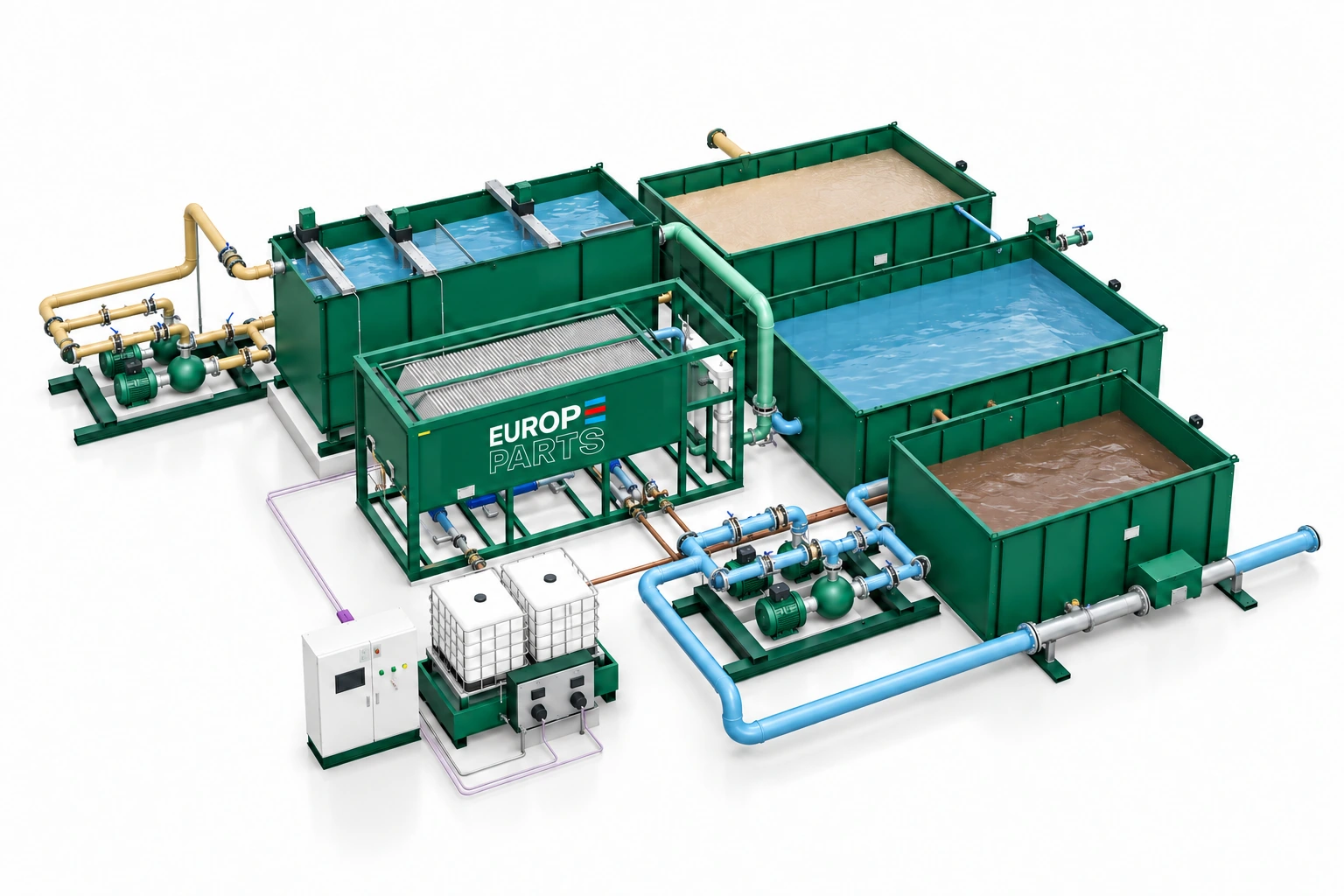
Where WRS 150 fits.
Feed equalisation, flocculation and clarified-water return are coordinated with the washing plant. Sludge removal must keep pace with the separated solids. A low average water flow may still contain significant peaks, so buffer storage is part of the selection. The WRS 150 name describes the reference washing circuit. It does not mean that 150 m³/h of water is recovered.
Reference configuration.
| Parameter | Reference configuration |
|---|---|
| Model | WRS 150 |
| Hydraulic treatment limit | 120 m³/h |
| Useful reaction volume | 30 m³ |
| Lamella clarification | 1 unit; 120 m³/h treatment basis |
| Reagent preparation | Two IBC reagent storage positions, dosing and polymer preparation; selection after water tests |
| Storage | Separate raw-water, clarified-water and sludge circuits |
| Indicative area — separate tanks | 22 × 16 m |
| Reference washing circuit | 150 m³/h; fresh-water demand verified through the process balance |
Planning areas are not transport dimensions. Operating flow is confirmed through settling tests, the solids balance and pump checks. High clay loads can require a lower throughput or a different configuration.
Washing flow and recovered water are different quantities.
The 30 m³/h difference between the reference washing circuit and treatment limit is an initial planning comparison. Actual make-up demand is recalculated with losses in aggregates and sludge, return streams and reagent preparation water. Net water recovery cannot be inferred from the model name alone.
A system built around the whole circuit.
Treatment & return
- Reaction and flocculation tank.
- Lamella clarification appropriate to the model.
- Polymer preparation and reagent dosing.
- Clarified-water storage and return pumping.
Operation & integration
- Raw-water collection and sludge management.
- Level monitoring and operating conditions.
- Pipe routes coordinated with the site.
- Cleaning and maintenance access.
The commercial proposal confirms the exact equipment, controls, civil works, assembly and connections included. Storage volumes and sludge-removal frequency depend on solids loading and operating hours.
Frequently asked questions
Is 120 m³/h guaranteed for every wash water?
This is the reference hydraulic limit. Admissible operating flow depends on solids concentration, clay characteristics, flocculation, pumping and sludge removal. Representative tests confirm selection.
What information is needed for a proposal?
Provide average and peak flow, working hours, representative water samples, material type, a site plan and the available route for sludge removal.
EUROPE PARTS · APPLICATION ENGINEERING
Build the right configuration for your site.
Tell us about your WRS 150 requirement, the material, operating flow and available space. Our team will prepare the equipment selection, layout and scope of supply.
EUROPE PARTS · DALMAN INTERMEDIERE SRL · Bucharest, Romania