
EUROPE PARTS · EUROX SERIES · FIELD UPDATE
1,500 truckloads crushed.
Still on the first side.
That is the field result reported for the EUROX-1415-HCC blow bar shown here: 1,500 truckloads of stone processed, with the first working face still in use.
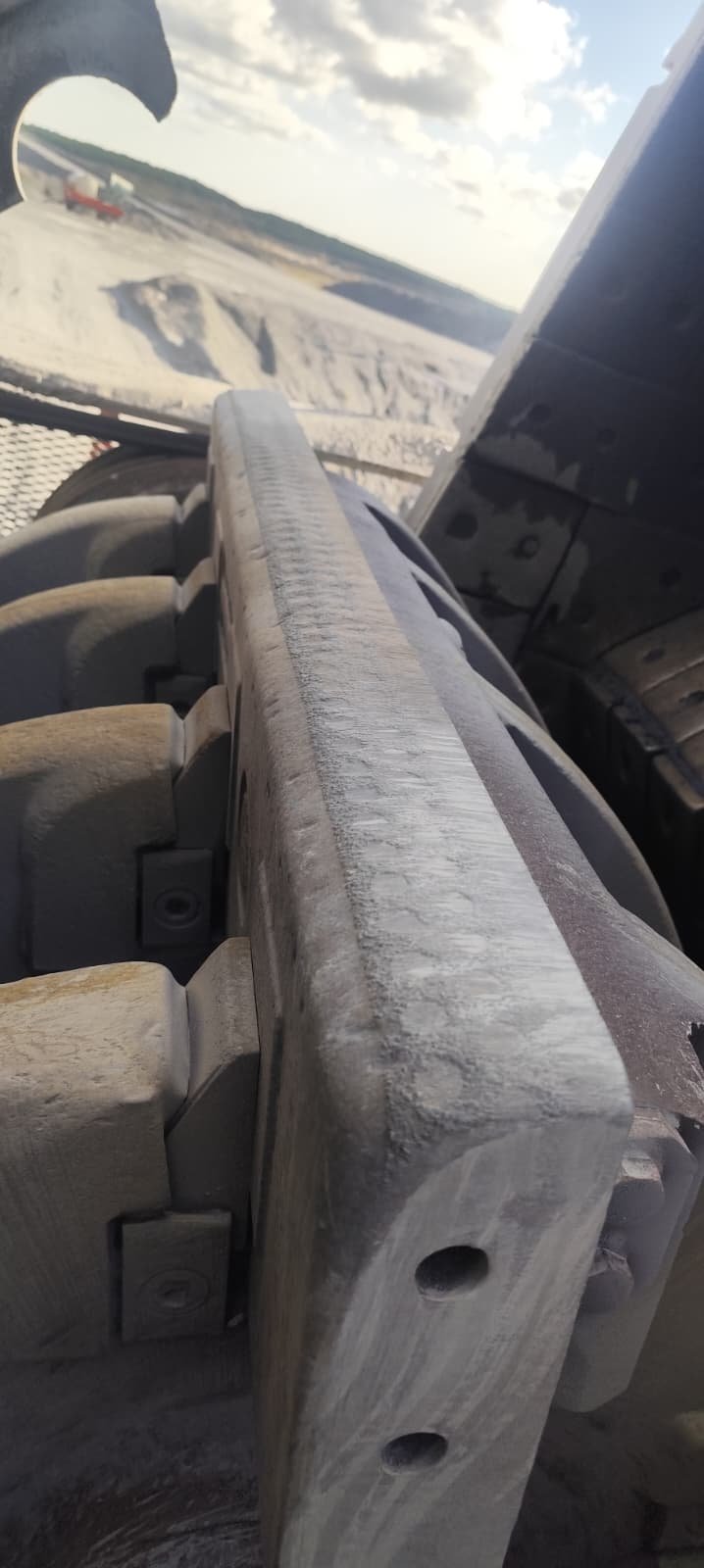
EUROX-1415-HCC
High Chrome Ceramic blow bar
Unit weight: 436 kg/pc
Application: impact crushing
More service from each working face
Europe Parts has supplied the EUROX range for years, supporting crushing operations with wear parts focused on long service life and fewer replacement stops.
In this application, the first face remains in service after the reported 1,500 truckloads.
Which blow bar material suits your application?
The right blow bar for abrasive, pre-crushed stone may differ from the right choice for large lumps and heavy impact. Start with three questions: what rock are you processing, what is the feed size, and how demanding is the impact duty? The aim is useful wear life with fewer stops for replacement.
Manganese steel: for demanding impact duty
Manganese steel can suit coarse feed and heavy impact in applications with lower abrasion. Its surface work-hardens under impact. It needs sufficient impact loading to develop that effect, so it is not the automatic choice for fine, highly abrasive feed.
Martensitic steel: balancing impact and wear
Martensitic steel is an option where abrasion resistance and impact toughness are both important. It can be considered for natural stone and recycled materials, depending on the feed and crusher. Ceramic-insert versions aim to improve wear resistance in the working zone while retaining the characteristics of the martensitic body.
High chrome and chrome–ceramic: when abrasion drives replacement
High-chrome blow bars can be considered for abrasive, pre-crushed stone with controlled feed size and no uncrushable metal in the feed. In High Chrome Ceramic versions, ceramic inserts help protect the wear zone. EUROX-1415-HCC belongs to this family. This approach is particularly relevant where abrasion, rather than extreme impact, determines replacement frequency.
Limestone, granite, basalt or gravel: start with the rock and the actual duty
Tell us whether you process limestone or dolomite, granite or basalt, river gravel or recycled material. We then consider abrasiveness, feed size and feeding conditions together. Two quarries processing the same rock family can still experience different wear conditions.
For less abrasive rock fed in large lumps, impact toughness may matter more than maximum hardness. For abrasive material already reduced to a controlled size, wear resistance becomes a priority, and high chrome or chrome–ceramic may be options. For recycled concrete, reinforcement and other foreign objects must also be considered.
Which feed dimensions should you send us?
Send the size range entering the crusher and the largest lump size, not only the finished product size. For example, if your feed is 0–150 mm or 0–300 mm, tell us the actual range and whether oversize pieces occur. These are examples of information to share, not operating limits for EUROX-1415-HCC.
Large lumps increase impact loading; uniform, pre-crushed feed allows a different alloy choice. The permitted feed size depends on the crusher model, rotor configuration and blow bar material together. Rock name alone is not enough to select the alloy.
Let’s find the right solution for your plant
Send Europe Parts your rock type, feed size and crusher model, together with a photo of your current blow bar. Tell us how it wears or how often you replace it, and we can compare the options and propose a solution suited to your application.
Explore our impact crusher blow bars and other crusher wear parts.